1 Jan Sandstrom A Motorbike Odyssey (1989-2002)
 Jan Sandström 1954-
In 1986 Christian Lindberg and Jan Sandström met for the first time in Iceland, and this meeting proved to become a very important moment in the history of the trombone. No other concerto than "A Motorbike Odyssey" has had a bigger impact on the classical music scene in the whole 1990s. It was the perfect "crossover" piece, a piece that brought young people from other genres in to hear classical music concerts, a piece that contemporary composer respected, a piece that the normal classical audience took to their heart despite its avantguard character, and it made bikers around the world put it into their jukeboxes in their cafés. Since its premiere in 1989 with Chrstian Lindberg, Esa-Pekka Salonen and the Swedish Radio Orchestra it has been performed more than 653 times, and must then be the most frequently played modern concerto since its premiere.
The piece is inspired by Christian Lindberg´s travels around the world, and his experiences in Florida(paddling canoe among alligators), Provence(a motorbike race in a medieval village in Provence) in Australia(a cadenza dedicated to the aboriginal people) and finally a motorbike ride in to heaven. It is a phenomenal showpiece that could as well be seen as a pure concerto for trombone, but it has many layers: religon, humour, music theatre, beaty, wildness, and above all: It has proved to be regarded as a milestone in contemporary composition technique. The piece was written for and dedicated to Christian Lindberg and in addition to the 3 years of work before the premiere, the piece has been revised 2001-2002 by Jan Sandström and Christian Lindberg in close collaboration. It exists in two versions: a shorter one of 10minutes and a longer, lasting 20minutes.
2 Leopold Mozart Concerto for Alto Trombone (1756)
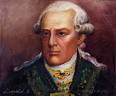 Leopold Mozart 1719-1787
At the beginning of the 1960s the classical trombone concerto was a
completely unknown entity in the established musical life of Europe. So when
Nicolas Harnoncourt released a recording of the incomplete concerto by Georg
Christoph Wagenseil this was considered quite a sensation. At the time this
trombone concerto was considered a one-off rarity. A couple of years later,
a trombone concerto by Beethoven´s teacher Albrechtsberger was discovered
but, because of the virtuosity of the solo part and the difficult trills,
musicologists concluded that it could not actually have been written for the
trombone. They assumed that it was really intended for the French horn. If,
during the 1960s, scholars had been aware of the existence in the late 18th
century of a great master of the alto trombone, the Austrian musician Thomas
Gschladt, they might have drawn different conclusions. Gschladt was a
colleague of the famous French horn player Joseph Leutgeb for whom all of
Mozart´s horn concertos were written.
Research and work on the reconstruction of the scores of Mozarts horn
concertos has constantly revised our understanding of these works throughout
the years since Mozart died. Unfortunately, the facts about the trombone
concertos presented on this CD, probably all written for Gschladt, have been
hidden for so long that there are even more question marks surrounding these
pieces. With help from various sources including such experts as Kurt
Janetzky, Mary Rasmussen, Richard Raum, Ken Shifrin, Randy Kohlenberg and
Stephen Anderson, I have been trying to lay the jigsaw puzzle that confronts
us regarding these pieces. I have now succeeded in making editions of these
four highly virtuosic concertos for the alto trombone which bear witness to
a golden period for the instrument between 1756 and 1780.
Gschladt´s relations with the Mozart family were very warm. At the 1756
audition for the position in Salzburg, Leopold was apparently one of the
jury members, at the side of Kapellmeister Eberlin and the Concertmeister
Ferdinand Seidel. Gschladt had to play not only trombone, but his
audition also required him to play the violin and the French horn.
Gschladt´s salary was initially 8 florins and 20 kreutzer monthly. The court
composers Eberlin and Adlgasser soon found out what a fine musician he was
and trombone solos started to appear in the oratorios and serenades. Thanks
to this his salary was raised significantly, being almost doubled to 15
florins and 40 kreutzer a month in June 1767.
Leopold Mozart took advantage of this remarkable trombonist
right after the audition in 1756. He was just working on a serenade. (This
is the only extant serenade by Leopold though according to letters he wrote
around 30 such works!). It included two movements for Gschladt´s colleague,
the trumpet player Johann Köstler (these two movements were dated 1755 and
were later issued as a trumpet concerto). On hearing Thomas Gschladt´s
fabulous audition he wrote these three wonderful movements for trombone late
in 1756. As far as we know they were not published as a concerto in Leopold
Mozart´s lifetime but, as you can hear, they make a beautiful concerto for
the trombone in the context presented on this CD , just as do the three
movements by Michael Haydn (tracks 1-3). An interesting note in the score of
the Leopold Mozart Serenade states that Mozart admired Gschladt so much that
he wanted only him to play it. If he was not available, Mozart preferred
these movements to be played on the viola!
Thomas Gschladt probably made the biggest mistake in his life by leaving
Salzburg for Olmütz in 1769. In Salzburg he was surrounded by fantastic
composers who all admired him. And in 1767, at the height of his career, the
young Mozart wrote a great solo for him, the 10-minute aria "Jener
Donnerworte Kraft" for tenor voice and solo trombone. Had he stayed, or like
Leutgeb, followed Mozart to Vienna, we would no doubt have had one or two
trombone concertos by Mozart. He was considered a far greater musician than
Leutgeb, better paid and also more respected by the Mozart family. Yet the
eagerness of Leutgeb gave the French horn 4 masterpieces by Mozart. If
Gschladt had shown half the enthusiasm of Leutgeb he would probably have
persuaded Mozart to do the same for him and the trombone would have had a
quite different history as a solo instrument. Gschladt´s time in Olmütz as
Thurnemeister was obviously not a happy period of his life. Only months
after his arrival he got into a dispute with Anton Neumann, Kapellmeister of
the Olomouc Cathedral about the quality of the musicians. This ended in a
declaration by Gschladt in July 1770 that he would never again play in the
church. However on 9th October 1777 he broke his promise and it is on this
occasion, in the opinion of Ken Shifrin, that the Wagenseil concerto was
premièred.
On March 20 1803 after having previously been denied a civic pension (79
years old!) Gschladt reapplied to the city magistrate with a document that
gave a detailed account of his finances. His total assets came to 1200
florins of which no doubt 1000 was from the sale of his equipment to Joseph
Kunert, who was successful in his application for the post of Thurnemeister
in 1802. Whether or not "Thomerl" who lived for almost three more years,
ever received a pension is not known. But what we do know is that the pieces
presented on this CD would never have existed if it had not been for this
phenomenal musician!
We trombonists of the 21st century would certainly like to believe that he
was granted his humble request for a pension, as he almost certainly did
more for the trombone than anyone had done before him.
3 Ferdinand David Concertino for Trombone Op 4 (1837) 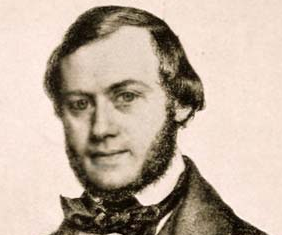 Ferdinand David 1810-1873
In Leipzig in the beginning of the 19th century there was a musician called Carl Traugott Queisser who according to roumors could play any wind instrument from the piccolo flute to the bass trombone, and every string instrument from the violine to the double bass. His main instruments however,seems to have been the trombone and the violine. At the same time he was the concert master of the Euterpe orchestra in the city and solotrombonist in the famous Gewandhaus orchestra under Felix Mendelsson-Bartholdy. Queisser was a good friend of Mendelsson, as was the concert master in the Gewandhaus orchestra: Ferdinand David. They offen met and played string quartet, and at one point in the 1830s Mendelsson promised Queisser a trombone concerto. However time went quickly, and Mendelsson fell in love, got married and forgot his promise. When Queisser reminded him of the fact, he suggested the then 25year old Ferdinand David to write the concerto, and in 1837 the Concertino Op 4 by Ferdinand David was premiered in Gewandhaus by Queisser under the baton of Mendelsson. The piece was a hugh success, and trombonists all over Europe started to play the concerto. The second movement, that David also made a version for violine and piano of, was in played at the funeral of Ferdinand David, and considered the most important of his works. David has been most famous for being a violine teacher, and the one to premiere Mendelssons famous violine concert, but he was no doubt a very talented composer with a great amount of self critic. Too much of this one could say, as he withdrew his first opera "Hans Sachs" despite some success with this, and decided to stop compose and primarily work as a teacher and violinist. The piece received its US premiere in 1923 by Cincinati Symphony Orchestra under Fritz Reiner, but since then the original orchestra material has been lost. In 1985 this was reconstructed by Christian Lindberg, based on an existing piano reduction, and Christian Lindberg has also composed a specific cadenza for this Edition on Edition Tarrodi.
4 Michael Haydn Concerto (1764)
Gschladt was a colleague of the famous French forn player Hoseph Leutgeb for whom all of W.A. Mozart´s horn concertos were written. Research and work on the reconstroction of the scores of these works has, ever since Mozart´s death constantly revised our understanding of these works. Unfortunately, the facts about the tromobone concertos presented on the CD, Probably all written for Gschladt, have been hidden for so long that there are even more question marks surrounding these pieces. With help from various sources (including such experts as Kurt Janetzky, Mary Rasmussen Richard Raum , Ken shifrin, Randy Kohlenberg and Stephen Anderson) I have been trying to piece together the jugsaw puzzle that confronts us regarding these pieces. I have now succeeded in preparing editions of these four highlyvirtuosic concertos for the alto trombone which bear witness to a goldebn period for the instrument between 1756 and 1780. I am proud to be able to present the concertos with a superb orchestra, the Australian Chamber Orchestra. The mosst remarkable and exciting of these discoveries is the three highly virtuosic movemets composed by Michael Haydn, brother of the great Franz Joseph, daing from 1764. At this time Thomas Gschladt had been employed for eight years in Salzburg and Leopold Mozart had written the three movements of his Serenade specifically for him (tracks 9-11). The court Kapellmeister Eberlin, Who died in 1762, had also written solos for him. The deputy Kapellmeister Lolli took over after Eberlin´s death but at the same time Michael Haydn was hired as court composer and orchestra leader. The horn virtuoso Joseph Leutgeb was also brought in from Viena, and in November Leutgeb and Gschladt were featured at a concert for the Emperor Hoseph and his bride. Michael Haydn apperas to have been present and the musicians went out for a drink at the Golden Spur afterwards. Aftter this, Haydn immidediately started working on a double concerto for horn and trombone. Following the premiere of this piece, Michael Haydn felt even more encouraged to write for the trombone. The result was a ten-movement work featrting a solo trombone in three of the movements and demanding the utmost virtuosity from the performer. The title of the work is unknown, as the first page is missing. It has however been known as "Michael Haydn´s trombone symphony" and was later published as "Divertimento in D" The first movement is here recorded for the first time. The second movement is one of the pieces that W. A. Mozart admired Michael so much for and that he presented on his tours when promoting Austrian music abrooad. The third contains a lively duet between horn and trombone that was sureleyplayed by Gschladt and Leutgeb at the premiere. Michael Haydn was only 27 years old when he wrote the work and, had he not become an alcoholic , he might have become an even more important composer than his brother Joseph. (At least that is the impression one gets when reading what Mozart had to say about him.)
5 Rimsky-Korsakov Concerto
Nikolai Rimsky-Korsakov wrote his trombone concerto in 1878 while working with the military orchestra in St Petersburg. It is one of a serie of concerti for wind instrument, and its length would maybe justify a different title like Concertino or piccolo concerto. It is somewhat surprising that Rimsky-Korsakov, who was author of one of the more important books in the art of orchestration, used the clarinets in such a way as he did, using repeated fast triplets that in a proper tempo only can be played with triple tongue, something that Rimsky-Korsakov said was only possible on "some" brass instruments and flutes. Christian Lindbergs orchestration for symphony orchestra presents the piece in a slightly different light, with the lyrichal second movement accompanied by the strings and bassoons rather than a choir of clarinets. Christian Lindberg has also composed the two cadenzas for the piece in this version on Edition Tarrodi.
6 Christian Lindberg Mandrake in the Corner
Writing about one´s own music turns out to be more complicated that one might imagine. On the one hand one knows everything that there is to know about the work. But one can hardly claim to have an objective view of the music. Nevertheless I shall try to describe Mandrake, which is the most successful piece that I had composed up until today(May 2000), as soberly as possible.
That I started to compose at all, at the age of 39, was first and foremost thanks to the composer Jan Sandström. The string orchestra Musica Vitae wanted to commission a piece for trombone and strings from him but he rang me up and said: You have given the first performances of more than 60 trombone concertos by all sorts of composers. Isn´t it time for you to write one yourself? Oh dear, I thought, remembering the shock of discovering at the age of 17, how awful the brass quintet that I had written sounded - something that had caused my to stop composing immediately. I can´t, was my natural reply. But Jan Sandström gave me some sort of advice: Think of yourself as a five-year-old doing a drawing. He does not worry about whether it is good or not. He just does it because he wants to. Nor has he started to compare himself with other people or to copy them. So his drawings are always unique. With this in mind I started composing again.
To my great surprise Arabenne, my first piece, was enthusiastically received by audiences and critics as well as colleagues. So I thought: Then I can just carry on until somebody complains! Sandström helped me with various technical matters in a sort of postal course by e-mail. The first lesson was how to use a computer in composition.(Arabenne was written by hand in traditional manner.) I opened my first page of score on my Macintosh Quadra 700, giving the name Mara Mara to the piece I was sketching. As it progressed the music began, in some very strong way, to remind me of film music to a second-rate TV thriller and I became very interested in it. I carried on with the piece and was suddenly remined of the wonderful comic-strip figure Mandrake the Magician, but he kept in a corner like a protective spirit. When I had written a sketch of about five minutes´ duration I decided to use the material to attempt to write a traditional trombone concerto and the name Mandrake in the Corner was born. My intention was not that it should be performed but that it should function as an étude for learning the techniques of composition. However, two orchestras that had heard Arabenne offered to perform Mandrake, The Tapiola Sinfonietta wanted a version for chamber orchestra and the North Texas Wind Band requested a version for wind orchestra. An inexperienced composer can hardly have better fortune, and after two performances I had a clear idea of what needed revising.
On 3rd of January 2000 I completed the version of the piece for trombone and orchestra wherupon it was rushed to Singapore to be recorded on the 24th of January for inclusion on the BIS-CD-1228. To describe the music would, I believe, be pointless given that I have such a subjective picture of it. But as a curiosity I can mention that the first movement came to me largely at my home in Stockholm, while the second movement was mainly conceived at my country home in the Stockholm archipelago. I sketched the final movement on a very small Yamaha synthesizer/computer on a flight from Singapore to Barcelona. I imagine that the character of the music is influenced by the invironment in which it is created...
7 Christian Lindberg Arabenne
As a teenager I felt an urge to compose and I actually wrote a brass quintet. When I heard the result at the first rehearsal I was so appalled that I decided to abandon this ambition for ever. But over the years I have learnt that almost all the composers who have written trombone concertos for me (65 up to date) suffer something similar in terms of anxiety and shock when they first listen to a new composition. It was partly that insight that persuaded me, having now passed the age of fourty.,to begin writing music again. But there was antoher impulse too.
When the string ensemble musica Vitae wanted me to tour with them, a your or two ago, we jointly decided to commission a piece from Jan Sandström. But when Sandström heard about the commission he rang me up and asked: Haven´t you performed enough trombone concertos by other people? Isn´t it time for you to write something yourself? His advice to me when I sounded somewhat doubtful was: Whatever you do, don´t try to be clever, just write your own music. Don´t worry about wether it´s good or bad.
I started composing in March 1996 and finished the piece in October 1997. Initially a number of glissando motifs in octaves presented themselves to me, idiomatic both for strings and trombone, together with pizzicato notes that are imitated backwards on the trombone with a plunger mute. The whole thing developed, for some mystical reason, into something Arabian, and the name Arabenne, (which has no specific meaning) was born. I drew up guidelines for form and harmony and then let the piece slowly develop with my imagination in full bloom.
In the course of composition I noticed that sonic memories from the old city in Jerusalem, which had earlier fascinated me, made themselves felt and began to make their mark on the music. But the images were much too abstract and ambivalent for the piece to be considered as programme music. I would rather see Arabenne as a concert piece for trombone and strings in five parts based on the various instrumental techniques such as voice multiphonics, lip multiphonics, Bartók pizzicati, glissandi, growl and col legno effects. My musical aim was to emphasize the sensual and melodic character of the trombone.
Since the piece has been so very much more favourably received than I had anticipated at the fourty or so performances that have taken place all over the world, and has led to further cexciting commissions, the shock of my youthful experience with the brass quintet has now passed. Even though I do not intend to take up again the heroic compositional ambitions of my youth, I hope to carry on writing unpretentious music in the same spirit as Arabenne.
8 J G Albrechtsberger Concerto
At the beginning of the 1960s the classical trombone concerto was a
completely unknown entity in the established musical life of Europe. So when
Nicolas Harnoncourt released a recording of the incomplete concerto by Georg
Christoph Wagenseil this was considered quite a sensation. At the time this
trombone concerto was considered a one-off rarity. A couple of years later,
a trombone concerto by Beethoven´s teacher Albrechtsberger was discovered
but, because of the virtuosity of the solo part and the difficult trills,
musicologists concluded that it could not actually have been written for the
trombone. They assumed that it was really intended for the French horn. If,
during the 1960s, scholars had been aware of the existence in the late 18th
century of a great master of the alto trombone, the Austrian musician Thomas
Gschladt, they might have drawn different conclusions. Gschladt was a
colleague of the famous French horn player Joseph Leutgeb for whom all of
Mozart´s horn concertos were written.
Research and work on the reconstruction of the scores of Mozart´s horn
concertos has constantly revised our understanding of these works throughout
the years since Mozart died. Unfortunately, the facts about the trombone
concertos presented on this CD, probably all written for Gschladt, have been
hidden for so long that there are even more question marks surrounding these
pieces. With help from various sources including such experts as Kurt
Janetzky, Mary Rasmussen, Richard Raum, Ken Shifrin, Randy Kohlenberg and
Stephen Anderson, I have been trying to lay the jigsaw puzzle that confronts
us regarding these pieces. I have now succeeded in making editions of these
four highly virtuosic concertos for the alto trombone which bear witness to
a golden period for the instrument between 1756 and 1780.
The concerto by Albrechtsberger has also given rise to questions that can
not be answered with any certainty. When the concerto was first discovered
it was thought that the title on the cover "Concerto in B del Giorgio
Albrechtsberger" with the subsequent note "pour trombone" was a mistake. The
solo part was considered too virtuosic, and musicologists could not
understand how these trills could be played on the trombone. Later, when the
relevant pieces by Mozart, Eberlin, Reutter and Adlgasser were found which
all contain trills of this kind, it was clear that lip trills were fairly
common on the sackbuts of the time; at least it is evident that Gschladt had
mastered them. Later research suggested that the work was premièred by a
trombonist called Roman Korner in 1769 but Richard Raum has subsequently
argued against this conclusion. The reason for doubting that Roman Korner
could have played the piece, was that he would have been only 19 years old
at the time and that there is no other evidence to suggest that Roman Korner
was a virtuoso on the level that this particular piece required. What Raum
is suggesting is that Albrechtsberger was present at the concert at which
Leutgeb and Gschladt performed Michael Haydn´s double concerto, in 1763,
that they met, and started to discuss the concerto at that date. Later, when
Gschladt left Salzburg to take up the duty as Thurnermeister in Olmütz he
passed the place outside Melk where Albrechtsberger was living at the time.
The year was 1769. In a wonderful article in Brass Bulletin Raum has tried
to reconstruct a possible meeting between Albrechtsberger and Gschladt,
based on information that he found in his research on Gschladt, Eberlin,
Michael Haydn, Albrechtsberger, Reutter, Wagenseil, Adlgasser and Mozart
father & son.
In the words of Gschladt, recreated by Richard Raum:
"Our trip to Olmütz took us through Melk, Vienna and Brünn. During this trip
I once again made contact with Johann Georg Albrechtsberger, who was staying
at his father´s house in Ebersdorf, a small village just four kilometres
from the Melk monastery. In fact, the elder Albrechtsberger operated an inn
there, and we were able to take lodging with him for a few days before
continuing on our journey. Shortly after arrival Johann appeared and invited
us to dine with him. A most enjoyable and rewarding conversation ensued.
"Herr Gschladt" he began.
"Please call me Thomerl as my friends do" I interrupted.
"Thomerl, then. I´m so pleased to talk. You probably aren´t aware of it, but
I knew you many years ago. You see, I was born in Klosterneuburg."
"Yes, of course? It´s only a few kilometres from my birthplace in Stockerau.
But how did you know me?"
"By reputation. I was only a young boy by the time you left for Salzburg,
but your abilities on the trombone were already well known in the area."
I was astounded. This conversation was indeed helping me overcome the
depression on leaving Salzburg and was giving me confidence for the future.
"And those of us working at Melk were certainly aware of the fine musicians
at Salzburg" he continued. "By the way, how is Michael Haydn?"
"Michael? He is fine. But do you know him as well?"
"Michael and I spent a year together in 1755 studying philosophy at the
Lower Jesuit Seminary in Vienna"
Michael studied philosophy at a Jesuit Seminary? Would wonders never cease?
The conversation continued through dinner, but I had a feeling that he
wanted to say something else and was hesitant. Finally, when we were quite
agreeable from the effects of good food and wine, Johann broached the
subject he had on his mind.
"I still remember the concert at Lambach when you played a solo for the
Emperor Joseph and his bride. I had made the trip especially to hear you."
I remembered the shy man who had approached me at the inn after the concert
and his offer to write a trombone concerto.
"Yes, I remember meeting you then. Tell me, have you written the trombone
concerto yet?"
A smile spread over his face. He stood up at once and disappeared into an
adjoining room. When he returned a few seconds later, he had a manuscript
that had obviously not been used. This manuscript he presented to me. It was
a trombone concerto!
"When I heard you play, I was inspired to write this" he said. "I only hope
that my humble music does justice to the noble voice that you have given the
trombone"
I was speechless. For a moment, Johann could not read my expression and was
apprehensive, but when I stood with tears in my eyes and shook his hand with
gratitude, he understood. In all my years, I have yet to hear a finer
concerto for the trombone.
Gschladt´s relations with the Mozart family were very warm. At the 1756
audition for the position in Salzburg, Leopold was apparently one of the
jury members, at the side of Kapellmeister Eberlin and the Concertmeister
Ferdinand Seidel. Gschladt had to play not only trombone, but his
audition also required him to play the violin and the French horn.
Gschladt´s salary was initially 8 florins and 20 kreutzer monthly. The court
composers Eberlin and Adlgasser soon found out what a fine musician he was
and trombone solos started to appear in the oratorios and serenades. Thanks
to this his salary was raised significantly, being almost doubled to 15
florins and 40 kreutzer a month in June 1767.
9 Jan Sandstrom Cantos de la Mancha
"A ho pa ge thegrian me!!! Me thseg a ra roa de mo!!! Ge tre thse be ho thsa ma ge!!!!!
This half mad musical code is the opening for Cantos de la Mancha, a tribute to the ridiculous, intuitive and emotional human being who is engaged in his impossible fight against rationalism and the intelect. For Sandström himself, the composition work on Cantos de la Mancha has in a sense been a final therapeutic settlement of the issue of restrictive rules, impediments and decrees in contemporary art music. The titles of the movements -
"to walk where the bold man makes a halt"
to row against a ruching stream", and
"to believe in an insane dream".
- speaks for themselves. It is not a question of succeeding, but rather of daring to lose one´s foothold for a while, of being carried away by one`s feelings even if punishment follows. And punished Don Quijote was, time and again, but he nonetheless believed in his insane dream and held his lance high!
Everything that happens in Cantos de la Mancha has a symbolic value beyond the music itself - very much in a realm of pure ideas, but also in the form of manifestly physical transfers from the stories in the book.
1.Introduction -- Cadenza
2. To Walk where the Bold Man Makes a Halt
The composers playful fight against his own windmills, and the presentation of Don Quijote as "the victor of all battles"
3. To Row against a Rushing Stream
The story of Zoraida, the daughter of a rich Muslim king in Algeria. The beautiful Zoraida secretly pushes into a prison yard, to some imprisoned slaves, a pipe containing a message. Only at the fourth attempt does the message reach the right man, the slave she has fallen in love with. The message reads:
"When I was a girl my father had a waman slave, who taught me the Christian prayers in my own tongue and spoke to me about Lela Marien (Virgin Mary). She told me to go to Christian lands and see Lela Marien, who loved me very much. I am young and beautiful, and have very much money to take with me. See if you cannot find a way for us to go; and you shall be my husband if you will. I wrote this; be careful to whom you give it to read. If my father finds out he will immediately throw me down a well and cover me with stones. May Lela Marien and Allah protect you."
4. To Believe in an Insane Dream
in Sierra Morena, Don Quixote meets a man called Cardenio who, driven out of his mind by an unhappy love affair, is running around naked among the bushes. Don Quixote transfers the whole story to himself and asks Sancho Panza to inform Dulcinea of Toboso that his master is running around with a bare rump because of his boundless desire for her. While awaiting Sancho`s return he passes the time by composing and inscribing, on the bark of trees and in the fine sand, numerous verses that are all in tune with his mournfulness. Of these verses, only the following two were fully legible when he was found:
Ye plants, ye herbs and ye trees,
that flourish in this pleasant site,
In lofty and verdant degrees,
If my harms do you not delight,
Hear my holy plaints,
which are these,
And let not my grief you molest,
though it ever so feelingly went,
Since here for to pay your rest,
Don Quixote his tears hath adressed,
Dulcinea´s lack to lament del Toboso
5. To Smile despite Unbearable Pain
Don Quixote meets a goatherd who insults him "a gentleman who must have some of the rooms in his brain vacant".
"--You are a very great rascal," replies Don Quixote, "and I am a good deal fuller than ever that whore´sdaughter, the whore that bore you, was."
What ensues is, for Don Quixote, a singularly humiliating battle that ends with him lying, bloody and beaten, on the ground. All the spectators laugh until they choke, except for Sancho Panza who is in utter despair.
10 Jan Sandstrom Don Quixote
This half mad musical code is a tribute to the ridiculous, intuitive and emotional human being who is engaged in his impossible fight against rationalism and the intelect. For Sandström himself, the composition work on Don Quijote has in a sense been a final therapeutic settlement of the issue of restrictive rules, impediments and decrees in contemporary art music. The titles of the movements -
"to walk where the bold man makes a halt"
to row against a ruching stream",
"to believe in an insane dream" and
"to smile despite unbearable pain"
- speaks for themselves. It is not a question of succeeding, but rather of daring to lose one´s foothold for a while, of being carried away by one`s feelings even if punishment follows. And punished Don Quijote was, time and again, but he nonetheless believed in his insane dream and held his lance high!
Everything that happens in Cantos de la Mancha has a symbolic value beyond the music itself - very much in a realm of pure ideas, but also in the form of manifestly physical transfers from the stories in the book.
1.Introduction -- Cadenza
2. To Walk where the Bold Man Makes a Halt
The composers playful fight against his own windmills, and the presentation of Don Quijote as "the victor of all battles"
3. To Row against a Rushing Stream
The story of Zoraida, the daughter of a rich Muslim king in Algeria. The beautiful Zoraida secretly pushes into a prison yard, to some imprisoned slaves, a pipe containing a message. Only at the fourth attempt does the message reach the right man, the slave she has fallen in love with. The message reads:
"When I was a girl my father had a waman slave, who taught me the Christian prayers in my own tongue and spoke to me about Lela Marien (Virgin Mary). She told me to go to Christian lands and see Lela Marien, who loved me very much. I am young and beautiful, and have very much money to take with me. See if you cannot find a way for us to go; and you shall be my husband if you will. I wrote this; be careful to whom you give it to read. If my father finds out he will immediately throw me down a well and cover me with stones. May Lela Marien and Allah protect you."
4. To Believe in an Insane Dream
in Sierra Morena, Don Quixote meets a man called Cardenio who, driven out of his mind by an unhappy love affair, is running around naked among the bushes. Don Quixote transfers the whole story to himself and asks Sancho Panza to inform Dulcinea of Toboso that his master is running around with a bare rump because of his boundless desire for her. While awaiting Sancho`s return he passes the time by composing and inscribing, on the bark of trees and in the fine sand, numerous verses that are all in tune with his mournfulness. Of these verses, only the following two were fully legible when he was found:
Ye plants, ye herbs and ye trees,
that flourish in this pleasant site,
In lofty and verdant degrees,
If my harms do you not delight,
Hear my holy plaints,
which are these,
And let not my grief you molest,
though it ever so feelingly went,
Since here for to pay your rest,
Don Quixote his tears hath adressed,
Dulcinea´s lack to lament del Toboso
5. To Smile despite Unbearable Pain
Don Quixote meets a goatherd who insults him "a gentleman who must have some of the rooms in his brain vacant".
"--You are a very great rascal," replies Don Quixote, "and I am a good deal fuller than ever that whore´sdaughter, the whore that bore you, was."
What ensues is, for Don Quixote, a singularly humiliating battle that ends with him lying, bloody and beaten, on the ground. All the spectators laugh until they choke, except for Sancho Panza who is in utter despair.
11 Darius Milhaud Concertino dHiver
In the 50s the American trombonist Davis Darius was very active trying to increase the solo repertoire for trombone and orchestra. He commissioned the wonderful Symphony for trombone and Orchestra by Bloch, and also inspired the french composer Darius Milhaud to write this Concertino d´hiver for trombone and strings.Milhaud wrote this piece on the ferry from Europe to America and while the first and third movements has a clear ouch of jazz, even if it is also built up at some places almost like a fugue, the second movement has a typical melancholic European touch , where the trombone gets to sing in its absolutely most beautiful register. The piece is as virtuosic for the strings as it is for the trombone.

Tidak ada komentar:
Posting Komentar